
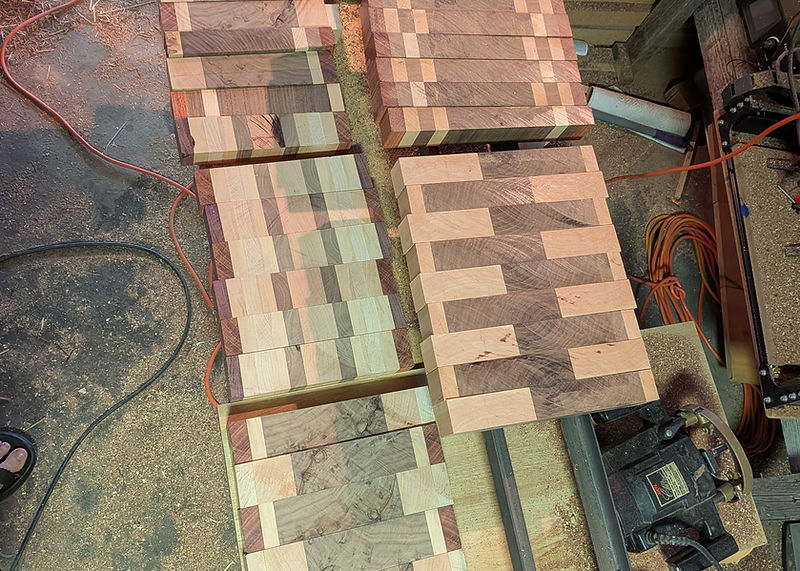
The workshop · Montana
Raw timber to the rack, one pair of hands.
This is the whole of it — how a board and a ring actually get made here. Stock pulled and milled in the shop, glue-ups clamped overnight, engraving cut on the CNC, resin poured into rivers and into the cracks the timber came with, then turned, sanded and finished by hand.

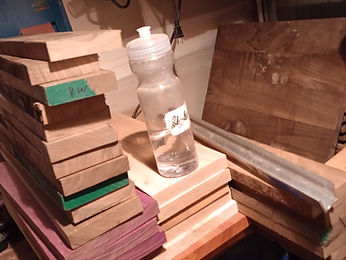
Stock on the shelf
Every piece starts as a plank or a block. Domestic hardwoods — walnut, maple, cherry, white oak, mesquite — sit next to the exotics, stabilized burl and antler, sealed at the ends and left to settle before anything is cut. Stock still moving gets set aside for a board rather than a ring.

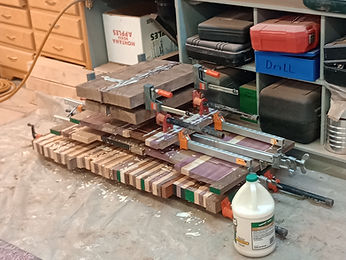
Cut, clamped, cured
Stacked-wood rings and pattern boards are laminated before anything touches a machine: species cut to size, glued flat, clamped, and left overnight. The clamp rack is the part buyers never see, and it is where most of the strength in a board comes from.

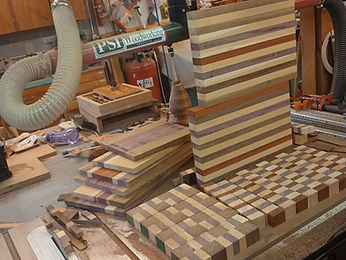
Cut, flipped, glued again
An end grain board is glued up twice. First into a solid block, then that block is cut into strips, each strip flipped so the grain stands on end, and the whole thing is glued again. That is why the pattern runs edge to edge, and why the board gives under a knife instead of showing the cut.

Carved on the CNC
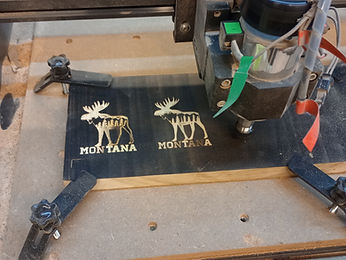
The CNC does the lettering and the picture work — names, dates, monograms, a crest, a lake map, a moose over the word Montana. I set the bit and the depth per job, clamp the blank, and cut the toolpaths. It is engraving, never burning, and shallow work can be filled with resin and sanded flush.
Rivers and natural cracks
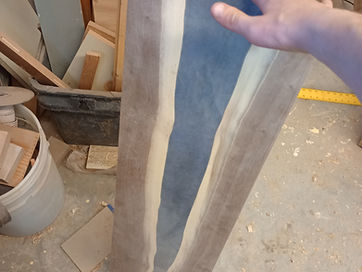
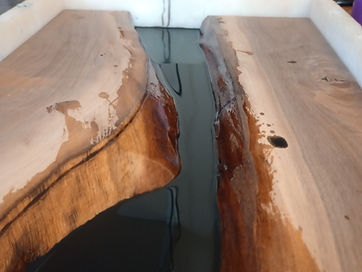
A pour is a two-day job and a three-day cure. A live edge pair gets a channel between the two halves; a ring blank gets whatever the timber already did — a split, a crack, a knot — filled in with the same pigments as the river boards and left solid. No vacuum, no filler wood: resin, colour and time.



Charred and joined
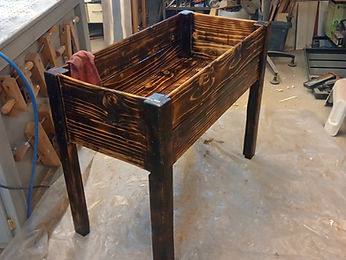
Some commissions ask for shou sugi ban: the surface burned with a torch, brushed back, then oiled so the grain reads black on black. That work is assembled on the shop floor, squared by hand, and left to dry where I can walk around it.

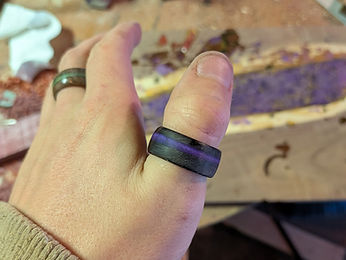
Turned, sanded, finished
Rings are turned from the cured blank, sanded through the grits to 2000, then finished — CA built up to a high gloss for a water-tight band, or oil and wax if you would rather feed it. The purple and green bands here are crack fills: resin sitting in flaws the wood came with, turned flush to the face.

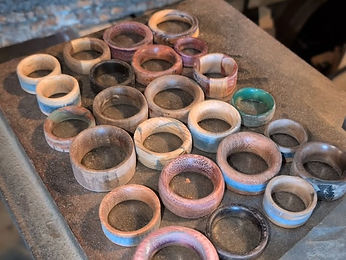
Finished, waiting on you
Finished work sits on the rack until it ships. No two are alike, because no two blanks are — species, figure and pour all decide what the band looks like. Rings and boards are made to order, and usually leave the shop in two to four weeks.
Next step
Everything on this page started as a request.
Tell me the piece — a ring in the designer, a board built to your size, or the thing that does not exist yet — and it goes through these same steps, in this same shop.

